

Why Smart Leaders Do Dumb Stuff (plus skiing)
notes on the Tahoe Avalanche

Earlier this week, as the storm of the season hit the West Coast and barreled eastward across a bunch of thirsty mountains, nine skiers died in an avalanche just off the infamous (and perennially unlucky) Donner Pass. It will go down as one of the most lethal slides in US history. (all in a season where the European Alps have seen more than their share of fatalities too)
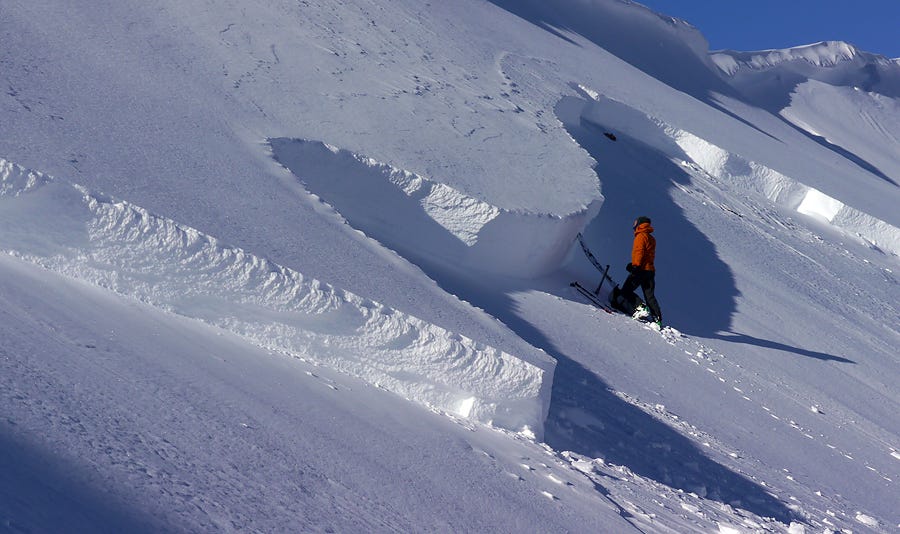
While most mountain guides and avalanche professionals in the community are withholding public judgment until a full assessment is conducted, plenty of folks online are chiming in with their more or less informed hot takes.
Why did they ski out to these remote huts when the storm was forecast well in advance?
Why did they leave the relative safety of the huts and make a dash for it in the first days of the storm?
How did three of the four guides on the trip get clipped by the very same snowpack they’d spent their careers studying?
***
I’ve skied and guided in terrain not far from those mountains, and as we speak, am about to go out and do my best to stay safe on the Rocky mountain end of that same storm!
But for now, wanted to share some broader thoughts on risky decision making in complex situations–using backcountry skiing as a lens to unpack how we messy humans, in so many domains of our lives, from geopolitics, to vaccine policies to business decisions to unsafe sex or substance use–all fall into the same traps.
It’s just when a poor outcome in the mountains becomes binary, life or death–we can see these patterns in starker relief, and hopefully learn from them.
Let’s start with the paradox that the more experienced an outdoor guide is, the more likely they are to get clipped in an avalanche!
That’s like realizing that Harvard MBAs are more likely to go bankrupt.
#enronFTW
Or that Olympic athletes are more likely to have heart attacks.
It’s kind of confounding.
Which is what one curious outdoor guide thought too.
But rather than settle for the same snow-geek science stuff, digging pits in the snow, analyzing ice crystal formation with those little jewelers loupes, he had a hunch:
It wasn’t the science of snow safety that was off.
It was the psychology.
The researcher’s name was Ian McCammon. He was a longtime NOLS outdoor instructor who doubled down on getting his PhD at the University of Utah. Still got to ski a bunch in the Wasatch mountains, but he was also making the savvy move from dirt bag outdoor instructor to something slightly more respectable. (an academic)
One of my co-founders of the High Mountain Institute in Colorado was good buddies with Ian, and shared a draft of his dissertation “Heuristics Traps in Decision Making” before it even got published.
It was so good, and so helpful that we immediately started teaching it in our avalanche courses at HMI. (it wasn’t until I read an Outside magazine article on it fifteen years later that I realized it had upended the entire industry!)
So today, we’re going to unpack Ian’s PhD dissertation, and share how his study of the paradoxical fact that experts get killed more often completely upended the entire snow safety industry.
(with some direct insights that apply to wherever and whomever you lead)
It was all about that paradox we’re talking about:
How come the smarter you are as a leader, the dumber the decisions you’re liable to make?
To return to our central puzzle: the more you study avalanches the more likely you are to die in one.
Experts make more mistakes than novices?
Ski patrollers, avalanche forecasters, and alpine guides die more frequently than tourists.
It’s not quite that simple. But it’s close.
First, to state the obvious.
Experts go out more often and put themselves in more dangerous terrain.
Novices tend to plunk around well known trails and might not have the gear, skills or ambition to get into the really sketchy stuff.
But experts? They know what they’re doing and they’ve studied the dynamics of mountains and snowpack more than anyone else.
So why were they dying way more often than they should have?
(and what does this have to do with you, scrolling through try-hard leadership posts on LinkedIn?)
Interestingly, leaders tend to face the same kinds of decisions regardless of the environments they lead in.
They never have enough information, and they have to consistently decide and lead others with less resources and certainty than they’d like.
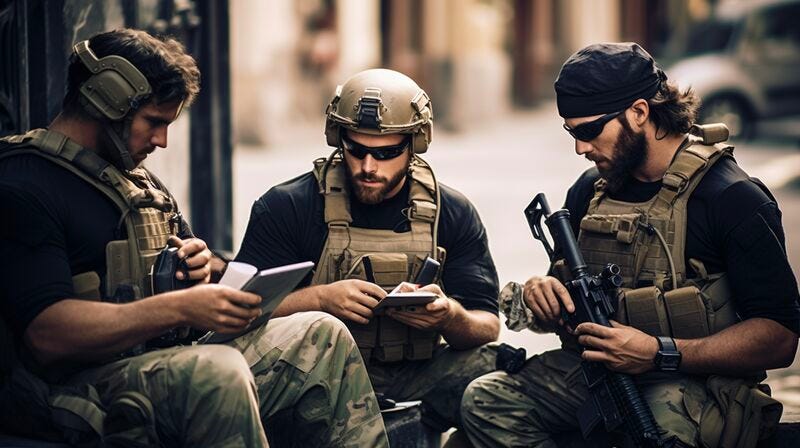
It’s just that those leaders whose decisions can have fatal consequences (like Navy SEALs and mountain guides) often learn, as a community, way faster than office and boardroom types.
That kind of learning’s called an After Action Review, in the business. Every time you complete a mission or an expedition, you debrief it. Right then. On the spot. With your boots still on.
Net result?
Lots more learning, driven by real world data, than you’d get from a pile of airport business books.
So to come back to our original question – why do pros get it wrong more often than novices?
Chalk it up to Socrates 101: the Curse of Knowledge. He famously said that he knew how much he didn’t know, which, paradoxically made him the wisest man in town.
It’s like the Dunning Kruger Effect (you’re too dumb to know you’re that dumb) but in reverse.
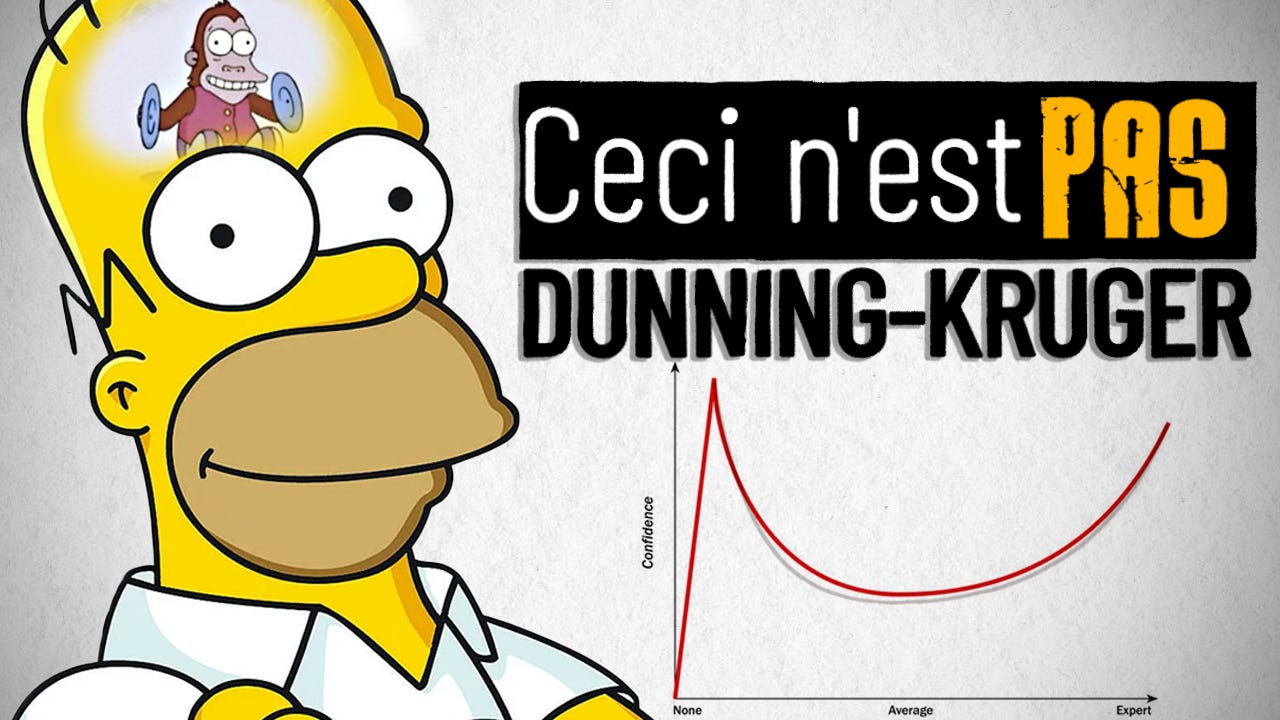
Socrates was too smart to pretend he knew it all.
But leaders these days?
Whether it’s opining on X or your Monday Morning All Hands meeting, or bopping around your favorite prestige conference, we’re all fronting, most of the time.
And that leads to false certainty, and fatal mistakes.
So how to break out of that trap?
Build on the accumulated, dispassionate insights of those communities of practice that live and die by their mistakes.
Become vigilant when you cross the threshold into a high stakes/high uncertainty situation.
Commit these next five factors to memory. Find the relevant analogues for your own life and work.
Beat yourself over the head with them and force yourself to act on that accumulated wisdom, not your own best (compromised) rationalizing in the moment.
While more accidents occur in the backcountry due to human errors than in assessing the snowpack itself–you could same the same of entrepreneurship, and all of our increasingly half arsed efforts to tackle migrant crises, AI proliferation, pandemics, ecological collapse, and the rest of our cheery polycrisis.
It’s less about the empirical realities of our challenges than it is the psychology we we’re addressing them with.
And in his dissertation research on avalanche safety, McCammon even boiled it down to a handy acronym to help us remember when we’re prone to forget: FACETS
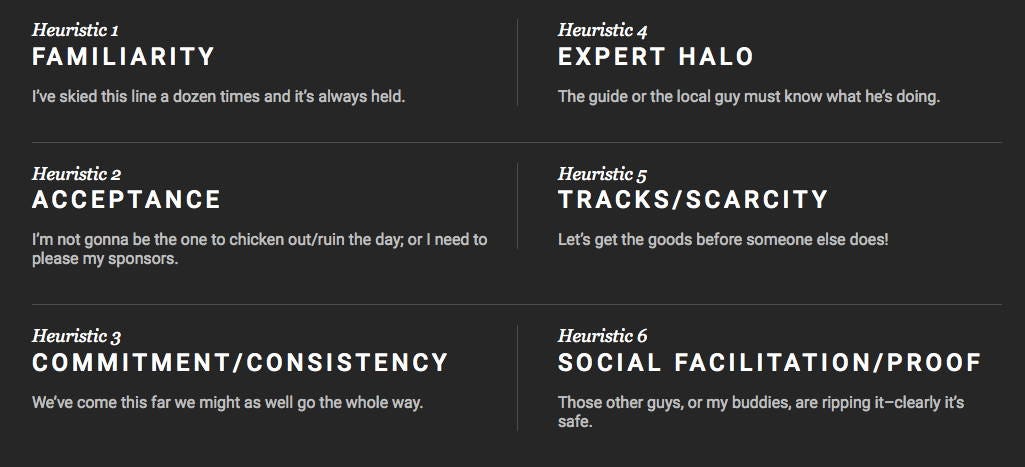
Familiarity
Acceptance
Commitment
Expert Halo
Tracks/Scarcity
(”Facets”, in this instance, don’t refer to the number of shiny surfaces on a diamond. They refer to a type of snowflake that has all its limbs broken off and starts to look and behave more like a ball bearing. No bueno for heavy snow sitting on top of those facets wanting to slide downhill, which is exactly what just happened in that Tahoe slide).
This is how smart people – experienced people – die more often than they should. But the slippery slope that leads to bad decisions in the mountains, comes for us all, wherever we sit.
Now that you’ve glanced over these five decision-making traps, think of how often they show up in front country leadership decisions.
Familiarity– assuming a terrain is safe because you’ve been there before.
“Last time we launched a new product, we absolutely killed with this strategy.”
Or “it’s only another IRS/SEC investigation, it’ll blow over...”
Or “Facebook is much more reliable for advertising than Snapchat or TikTok.”
Or “last time I took a bump of some friends’ ketamine at a party we had a great time (and it definitely wasn’t fentanyl!)”
We get lulled into complacency based on repetition. If things don’t look new and risky, we assume they’re familiar and safe. And that what worked last time will work again this time.
But when we miss what’s different, we miss what’s newly risky. (as all of those politicos at the Munich Conference were trying to get at as they affirmed that the World Order is over)
Acceptance– going along with the group’s decision even if you have concerns.
Adjusting to a “vibe shift” we’re committed to staying on the right side of. Following a trend that “everyone” seems to be chasing. Accepting a norm in our industry (or in parenting) that doesn’t make sense any more (if ever).
We’re tribal primates, and we’re hardwired to cue off each other and fit in. Often, to our detriment. This is typically the stuff of adolescence, when we were so sensitive to peer-group approval we’d occasionally lose ourselves to the hive mind.
But it still happens to grownups. Even professional ones. Lemmings also “go along to get along,” and look where that gets ‘em.
Commitment–feeling obligated to continue a plan even if conditions change.
Sunk Cost Fallacy 101. We’ve invested so much time, money, people, hope into XYZ it would be crazy to turn back now! Throwing good money/calories/time after bad doesn’t necessarily increase the odds of a good return.
For the victims in Tahoe this week, they’d had to book this trip to a sold out hut a year in advance. To cancel it in the face of an epic storm (and powder skiing) might have been one factor in their decision to push ahead, regardless of the forecast.
Sometimes turning around without the summit photo is the best thing to salvage what’s left.
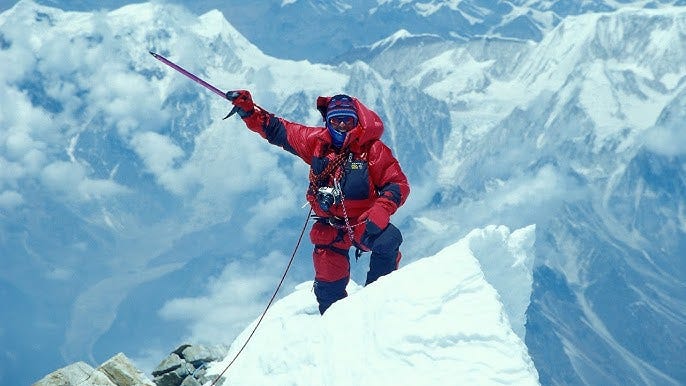
As Ed Viesturs, Everest climbing legend reminds us “Summiting is optional. Getting home is mandatory.”
How many of us are comfortable enough turning around shy of our goal, especially when we’ve come so far and it seems so close?
Expert Halo – overly relying on the opinion of a perceived expert in the group.
This one’s endemic these days with all the shouting on Instagram and podcasts by self-annointed experts – but think how often we defer our own ideas in favor of parroting/echoing an analyst’s, doctor’s, teacher’s or pundit’s point of view. Against our own better judgment.
Remember: no one, no one cares about your life, health, finances, children, company, or mortal soul more than you do! Not even those experts. No matter how confident they may appear.
Tracks/Scarcity – choosing a slope because others have already skied it (or might beat you to it), creating a sense of urgency.
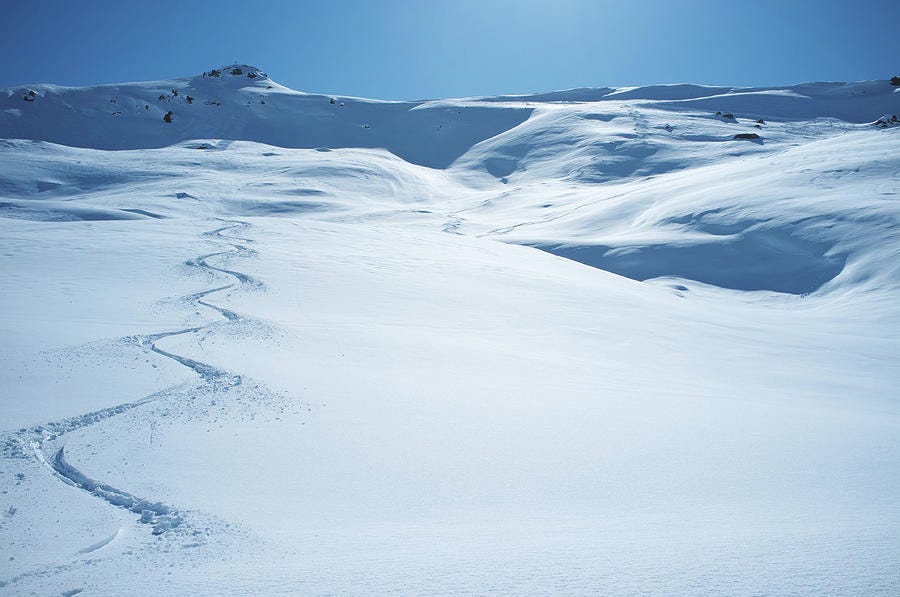
It’s well established in behavioral psychology that we’re strongly wired to avoid loss even more than we’re inspired to acquire gains. So when staring at a fresh slope of powder while another group is racing to get to it first, can nudge us to rush in.
Grab it all before someone else can.
(this sad fact just led to a multiple fatality on Shishapangma. Two women climbers and their teams got wiped out as they raced to beat each other to a new climbing record)
Now, translate this to investing in crypto, or AI or (less fun) EFTs or gold. Note the feelings of FOMO that spurred you NOT to miss out, to grab it before it’s gone.
Notice what motivated reasoning overrode your normal checklists and research.
Be fearful when others are greedy, and all that.
***
So that’s a quick overview of the leadership insights that arose from studying decades of avalanche accidents and the human factors that caused them.
It’s led to a complete revamping of snow safety training, which used to be super science-geeky, busting out magnifying glasses and thermometers to analyze the snowpack.
Now, they’re stripping a ton of that snow science out of the equation and doubling down on that messy tribal primate stuff.
How we decide, and how we lead isn’t always as smart as we think.
In corner offices, on LinkedIn, and family dinner tables, we can kid ourselves. We can rationalize our successes, and explain away our failures and never really learn what makes us tick.
But in the mountains, feedback is instant. And gravity is a harsh (but fair) teacher.
That’s how we get these kinds of insights. Large data sets. Unambiguous outcomes (life/death). Humbling insight into the human condition and the limits of expertise.
***
As snowboarding legend Jeremy Jones recently wrote in the Mountain Gazette, backcountry riders routinely accept risks that Tier One Special Operators would blanche at. It’s crazy!
At some point, all the logic and reason in the world go out the window when the white stuff falls, and dancing down a mountain is the siren song no Flow junkie can resist.
We forget to put the wax in our ears, and put it on our skis instead.
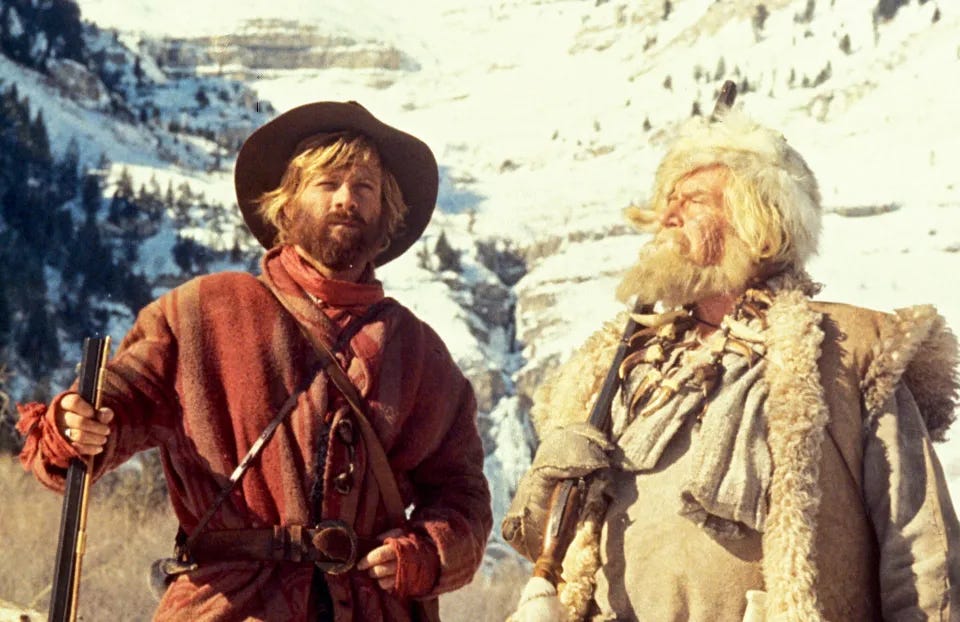
As the crazy mountain man in Robert Redford’s classic Jeremiah Johnson states:
The Andes is foothills, and the Alps is for children to climb!
These here Rocky Mountains is God’s finest sculpturings! And there ain’t no laws for the brave ones!
And there ain’t no asylums for the crazy ones!
And there ain’t no churches, except for this right here!
And there ain’t no priests excepting the birds.
So go out there and make some good decisions!
*or at least be more aware when you’re about to make some really bad ones ;)
If this tracks for you, and you’re tempted to put down some tracks of your own, consider joining the Flow Genome Project for our Flow and Snow adventure next month in Colorado. There’s one spot left, just tagging you here if you read this far and feel the call for some legit Flow training
Couched in exactly the kind of leadership and decision making we’ve talked about today. All while exploring the Rocky Mountain backcountry in all its springtime, blue sky glory.
Jamie
I've been aware of that halo effect, specifically, quite a few times while backcountry skiing. I can think I'm the less knowledgeable one or just a frightened little rabbit about the "perfectly safe" 35 degree angled slope with fresh snow, but then I have to consciously force myself to make my own evaluations and listen to my own risk tolerance and fears.
It's way to easy to blindly follow the seemingly smart leaders.
Very, very insightful and educational writing and particularly relevant to me. Thank you!
I just returned from a very high mountain in South America actually guided by the legendary mountaineer you name in this article. My lower gut alarms started firing when conditions got severe, and within a few minutes his did too. He immediately turned our team around. Disappointing to not summit that mountain...yes. Worth every penny to me to have him as our guide in the inclement circumstances making the correct call for all of us...absolutely yes! No injuries to any of us as a result. And I learned what it actually feels like to "trust my gut" when real mountain conditions go bad and to seek safety.